Booked For Christmas – Please Pass the Pearls

mcginley group 1-2

I can’t stop thinking about chocolate cigarettes and Buche de Noel, and I blame Phyllis McGinley.  In reading her wry,  light hearted verses for Christmas adults and Christmas children,  I have encountered once again the grown-up ladies who imbued my childhood with their self-determined elegance and natural mischief.  Ladies always neatly groomed, with soft leather gloves scented by perfume, and at least a butterscotch in their purse, in case you were either cranky or good.  It’s hard to write about McGinley’s Christmas books, as I intended, with these beguiling ghosts peeking over my shoulder.  So instead, I’ll tell the stories of the chocolate cigarettes, and of Buche de Noel.

The night Elaine presented Pammy and me with chocolate cigarettes for Christmas,  my mother’s  momentary dismay was not because her friend had given us play cigarettes.   In 1970, no one worried if practicing smoking at age six might somehow doom us to a lifetime tobacco habit.  No.  What worried my mother, as I see it now, was the chocolate.  At bed-time.  Near the new sofa.  “OOOOoooohh!” Mom cooed, watching us unwrap the slim hard plastic cases.  Her voice oscillated swiftly from delight to distress then into hearty laughter.  She did not want to offend her old and dear friend.  Elaine’s presence was like a medium, re-connecting my mother to the carefree girl who had once taken her chances in the bluster of late 1940s Chicago, dreaming of something glamorous and fine.

Entranced by our delicious gifts, we peeled the gold foil from the slender chocolate sticks.  We perched them properly between our index and middle fingers, taking tiny nibbling bites, the longer to enjoy the game of puffing imaginary chocolate smoke rings.  What could be more ladylike?  And with every second, the chocolate softened, staining our fingers with the greasy marks my mother feared.

We amused Mom and Elaine for a while, swanning around the living room in our nightgowns arranged like evening dresses, their arms tied halter-style behind our necks.  Until, I suppose, Mom gave up on “bed-time,” as she often did, and crept off with Elaine to drink coffee and smoke in the kitchen.

While the kitchen was good for smoking with friends, making coffee and eating cinnamon toast, no one could accuse my mother of cooking there.  Even she would have admitted that.  My father often made dinner, but when it was up to my mom, our food came out of a box.  Despite this culinary indifference, the French Chef was a regular program in our house.   Julia Child’s baudy, slightly soused irreverence delighted my mother as much as any comedian.  At Christmas time, WTTW had the excellent sense to rerun the famous Buche de Noel episode.  Hearing Julia Child announce the recipe set my mother off again and again.

As she watched from her spot curled up against the arm of the couch, Mom would cry out, “Buche de Noel!” and thrust her hand upwards in a vehement toast, a “Huzzah!” to Julia’s dessert.
“Buche de Noelll!”
“Buche de Noellll?” she’d croon, turning to us with a mockingly quizzical expression on her face.  “Buche de Noelll?”
Then, “Uhhuuuh, Buche de Noelll…”  nodding knowingly, as if discovering a  slightly naughty secret.

And finally, giddy with her own nonsense, she would return to cheering, “Buche de Noel!” until she laughed herself into tears.   This was one of my mother’s particular charms, knowing how to forget herself in the sound of silly words, so pleased with her own humor, she could scarcely speak.

***********

There’s more to be said about Phyllis McGinley’s cheeky spoofs on Santa Claus and Doormen, or her poignant descriptions of the humble creatures who paid tribute to a baby in Bethlehem.  She rhymes the smallest everyday occurrences  – the unwanted gift, the fed up St. Nick –  into images both sharply carved and fondly telling.

But tonight I am thinking of her readers – of women whose days were filled with commuter trains and skinned knees, and who were content to have it so.  Those inscrutable Mothers of our younger ages, with their pearls and wisdom won in a battle we never lived,  and cannot now explain to the girls who follow us.  But for our memories, re-constituted in a poet’s eye, these estimable women are almost gone, and we will not see their like again.

Posted in Uncategorized

Booked for Christmas – E.B. White Winter

cold weather lake-2

Excerpts from Cold Weather by E.B. White in plain face; all italics mine.

For about a month now we have had solid cold – firm, business-like cold that stalked in and took charge of the countryside as a brisk housewife might take charge of someone else’s kitchen in an emergency.  Clean, hard purposeful cold, unyielding and unremitting.  Some days have been clear and cold, others have been stormy and cold.  We have had cold with snow and cold without snow, windy cold and quiet cold, rough cold and indulgent peace loving cold.  But always cold.

I wake up this morning at about 5:30 – my usual unemployed time.  A few dozes added in brings the hour of actual rising to 6:03.  The first business of the day, which I can accomplish while still completely horizontal, is to consult the time and weather screen on my phone.  I perk up as soon as I see the temperature…sixteen!  That is a mighty hopeful improvement over yesterday, which was barely above 0 at this hour. Then, below the big, friendly double digit number, I see the fine print.  My eyes widen.  High for today 5 degrees.  Low minus 2.  I sigh, and get my feet on the ground.  This is going to need some coffee.

Morning comes and the bed is a vise from which it is almost impossible to get free.  Once up, things seem very fine, and there are fires to be made all over the house and the old dog has to be wrapped in a wool throw because of his rheumatism… Then everybody compares notes, each reads the thermometer for himself, and wonders whether the car will start.

An hour or so of reading (I struggle virtuously to keep “or so” from turning into an entire morning), approximately 12 ounces of coffee plus 35 minutes of meditation, and I must face the truth.  I  review the time and temperature screen again.  Seven degrees.  A ten-degree drop in 2 hours ain’t slowly falling temperatures, my friend.  I better do what I need to do in the relative warmth of the day’s seven remaining degrees.  That means, at a minimum and largely out of superstition, fill the gas tank and add some gasline anti-freeze.  I begin the process of getting dressed.

The question of clothes becomes a topic for everybody.  The small boy, who has relied thus far on a hunting cap with flaps down, digs up an old stocking cap as midwinter gear.  I exhume my Army underdrawers, saved from the little war of 1918.  The snow squeaks under the rubber tread of the boot, …

Cold weather  hasn’t posed a problem for me since I discovered you could put breadbags between your feet and socks, and thus continue wearing sneakers in the snow.  In recent years my tactical wardrobe has been based on down, and lots of it, purchased inexpensively from a jealously guarded secret thrift store that everyone knows about.  Long down, hooded down, shorter down, thinner down.  Down that once bestowed invincibility as I suited up for winter’s worst, recently identified as a culprit in my asthma.  Last year, I had to give up wool for the same reason – too much respiratory risk.  There hasn’t been time to find affordable down replacements in the aisles of my usual thrift stores.  (Such boons require persistence, and the grace of good luck.)  And the truth is – nothing, no nothing is as good as down.    For the time being my ensemble consists of a long, black fake fur dress coat (warm, fuzzy high collar) over a leather jacket (impervious to wind), and turban concocted most inadequately from a scarf.  For the first time since high school, I am improperly equipped for winter.

There is a fraternity of the cold, to which I am glad I belong.  Nobody is kept from joining.  Even old people, sitting by the fire belong, as the floor draft closes in around their ankles.  The members get along well together:  extreme cold when it first arrives seems to generate cheerfulness and sociability.  For a few hours, all life’s dubious problems are dropped in favor of the clear and congenial task of keeping alive.  …The cold hasn’t a chance really against our club, against our walls, our wool, the blaze in our stove, the clever mitten, the harsh sock, the sound of kindling, the bright shirt that matches the bright cap…  A truck driver, through a slit in his frosted windshield, grins at me and I grin back.  This interchange, translated means:  “Some cold, Bud, but nothing but what your buggy and my buggy can handle.”

By 9:38 the car is warm – in a manner of speaking.  Meanwhile, the fleece hat and scarves I bought last week are sudsing away in the laundry.  Tonight, when I go for Christmas steak and bourbon with my friend, I can finally wrap my naked scalp in something warm.  From the gas station, I’ll drive to Madison.  I believe it’s important to give the car some exercise today, even if I won’t get any.  At the pump next to me, a huge black and white pit bull watches from the driver’s side window.  Her sleepy, mellow eyes catch mine.  “Hi, hi you!”  I grin back at her.  I love to baby talk to dogs.  As I am adding the HEET to my tank, I hear:  “Molly, get in the back now.  Molly!  in the back!  In – the – back!”   Molly’s human has returned and is trying to be the boss of her.  I can see from the size of the links on the choke chain collar how well that is going.  “Her English isn’t so good, huh?”  I say smiling.  He laughs.  “We’re working on it!” and gets in beside Molly, crowding her out of her seat and into the back.  My gas pump clinks off at $26.  I wedge myself into my spot behind the wheel.  I barely fit, it seems, for all the extra insulation surrounding me.  In my purse, I have 2 book, in case I feel coffee-ish once I get to Madison, and mittens to go over my gloves.  The low winter sunlight casts everything in the glow of a warm afternoon, all day long.  I take off my gloves.  No matter that it is now 5 degrees.  Nothing your buggy and my buggy can’t handle.

Posted in Uncategorized

Booked for Christmas – Across the Frozen Pond

_MG_6438

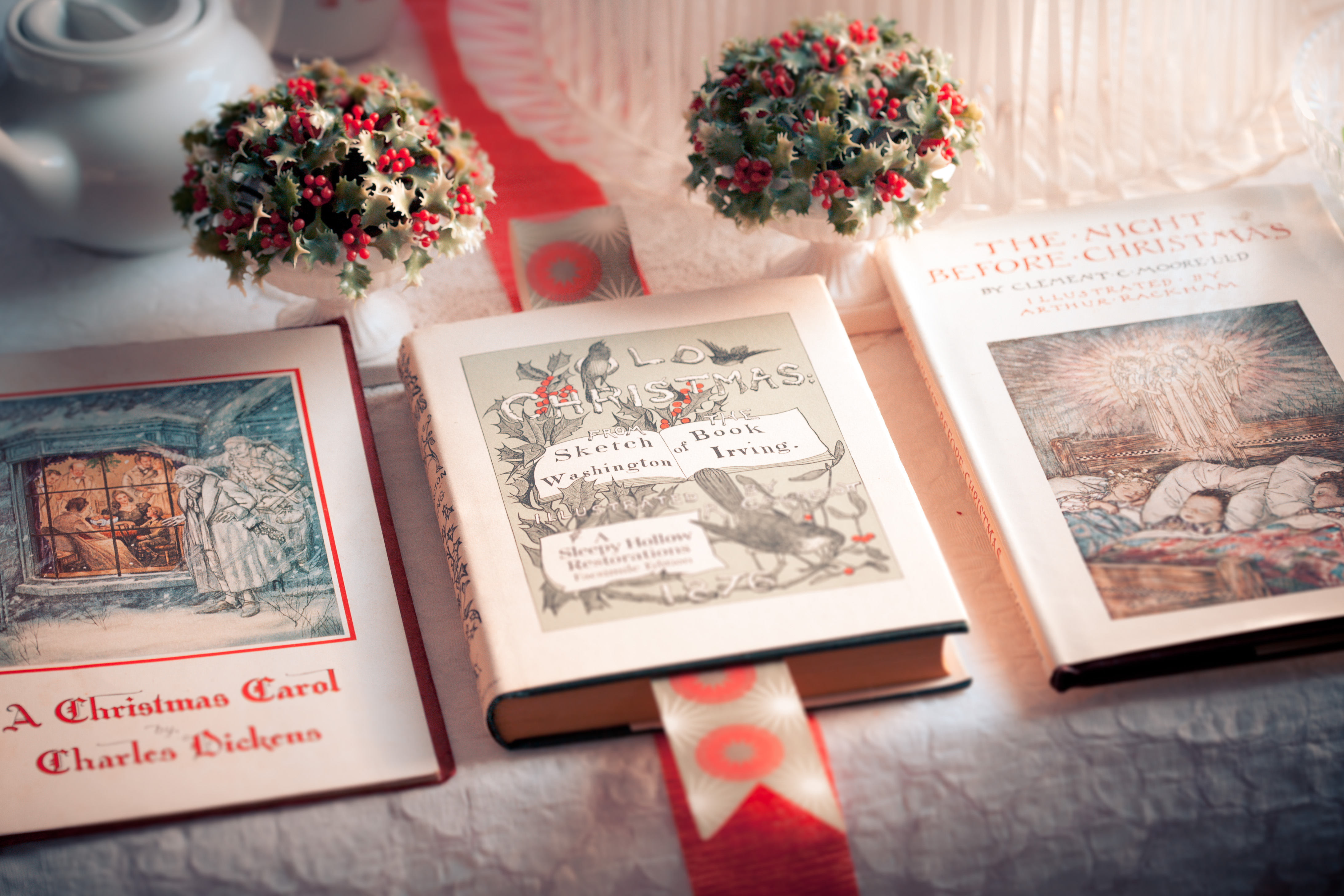
From left to right:  A Christmas Carol, by Charles Dickens.  Illustrator uncredited, seasonal promotion circa 1930 for Clyde’s Jewelry Shop, Green Bay, WI.  Old Christmas:  A Sketchbook, illustrated by R.Caldecott.  Sleepy Hollow Restorations;  Night Before Christmas, Clement C. Moore, illustrated by Arthur Rackham.  Weathervane Publishing, 1976.

“These Victorian-era Fathers of Christmas, one British, one American, shared an appreciation of humorous satire, of keen social observation, and of England… Also, Charles Dickens and Washington Irving both had a thing for sending people up chimneys…”  Chimneys Dark And Bright, Curator Magazine

I hate to pass the buck, but Washington Irving’s creative influence on Charles Dickens’ is so well documented, you can Google it.  And well worth the Google it is, too.  There’s just too much interesting, truly insightful thought by people who actually know what they are talking about for me to hope to synthesize here.  Never one to let facts interfere with an opinion I have formed, I will say this:  Not for nothing is A Christmas Carol the tale of a haunting.  For Victorians, Scrooge’s journey was a mirror, reflecting their fears of humanity lost to industrialization, and illuminating a means of redemption.  And they took to the work in droves, gobbling up six printings within 3 months of its publication.   Ebenezer embodied their struggle to re-define Christmas as a time not for mere nostalgia or piety, nor for hard-hearted economic concerns, but as a unique opportunity to face both the neglected impulses of charity, and the hidden suffering which underpinned Victorian prosperity.  Does this sound familiar to anyone?

Arthur Rackham’s incredible talent left its fingerprints all over the major storybooks of Edwardian England, a culture obsessed with the fairy realms.   Perhaps this is what made Clement C. Moore’s poem so suited to the time.  “Night Before Christmas” is a perfect vehicle for the Edwardian imagination, detailing an encounter with the mysterious forces of the fairy world, at work in the commonplace setting of an ordinary home.  And Rackham seems to have actually read the poem.  His Santa in an elf, a gnome, a sprite tiny enough to fit down the slimmest chimney, and powerful enough to magically bend gravity, time and reindeer to his will.  The tale is fanciful enough without overselling the drama.  Rackham’s images, though now historic, bring the enchantment of Christmas Eve right into our own familiar realm.  With powerful restraint, both style and palette imply reportage – “This is how it happened – in our home!

And as everyone from Jacob Marley to George Bailey knows, home is where the Christmas magic is always to be found.

Posted in Uncategorized

Booked for Christmas – Commence Jingling!

_MG_5989-3

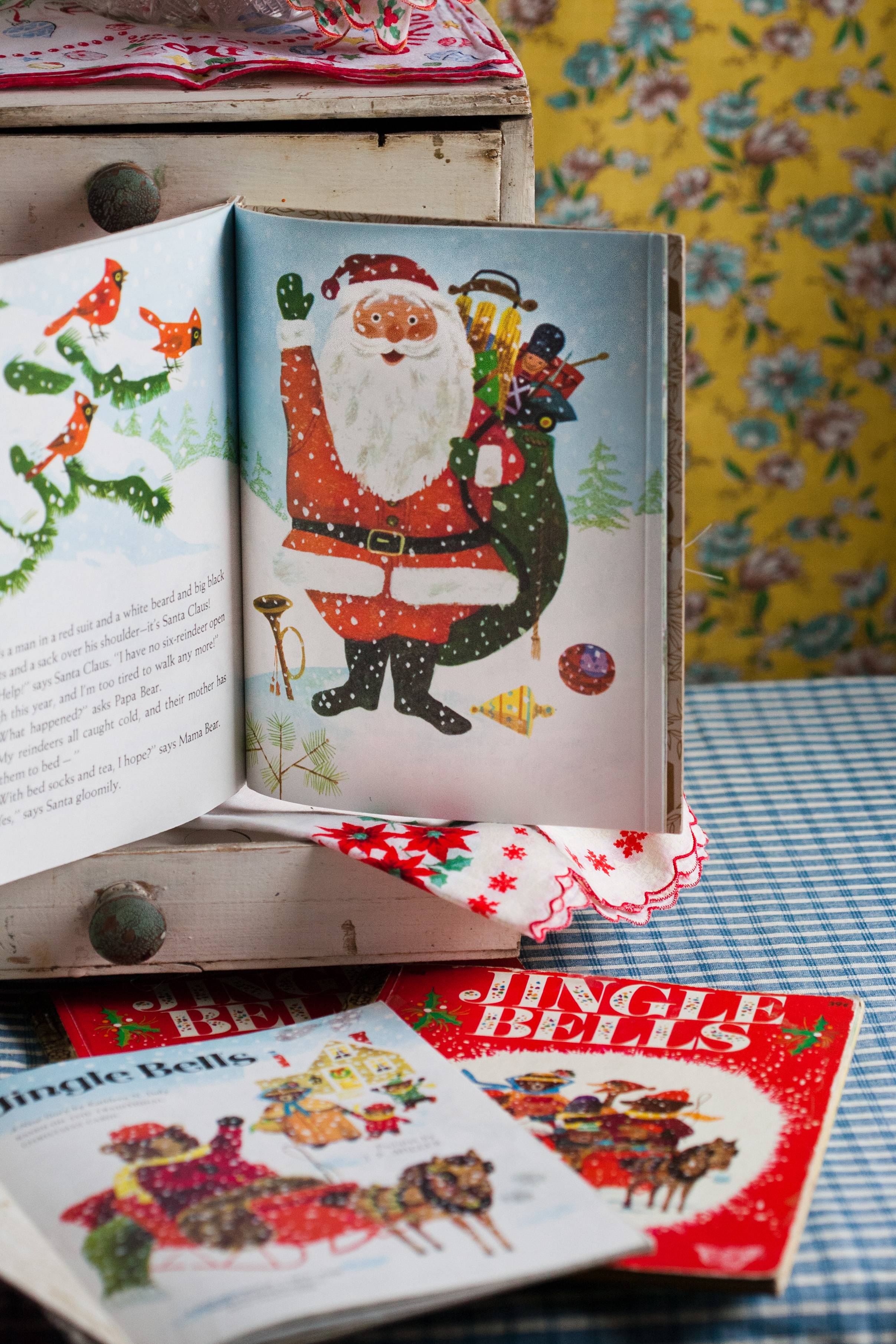
Jingle Bells, retold by Kathleen Daly, illustrated by J.P. Miller.  Golden Books, Racine WI 1964.

Oh, dashing through the snow and so on, with Papa Bear and family, you never know what might happen.  For example all your animal friends might hop on for a ride, including Miss Esmerelda Ostrich (she really can’t sing, you know) .  And look up ahead, isn’t that??  It IS, it’s Santa, stranded in the woods!  Don’t you think we’d better help him out, Jingle Bells?  What fun it is!

The creative team of Kathleen Daly and J.P. Miller inject mid-century panache into a snappy re-imagining of Jingle Bells.  Filled with telling details, luminous color and rollicking visual rhythm,  J.P. Miller’s illustrations stand shoulder to shoulder with Richard Scarry’s, and even Charley Harper’s (yeah, I said it).  Miller and Scarry were friends, and it is easy to see how they must have influenced each others’ style.  Kathleen Daly was a member of  Golden Books‘ in house staff of talented creatives whose collaboration fueled one of the most prolific and enduring enterprises in the history of juvenile literature.

Wouldn’t you like your very own Jingle Bells, to sing and read to a little someone  – or to share with a larger someone who likes charming, nostalgic things?  You would?  Well, it so happens I have a copy to spare!  So if you will be the first person to leave a comment, I will send you one, and it will be my pleasure, treasure!

Posted in Uncategorized

Booked for Christmas – Spread the Pathos

_MG_5624-2

For the friend who has everything, why not give the gift of tears?

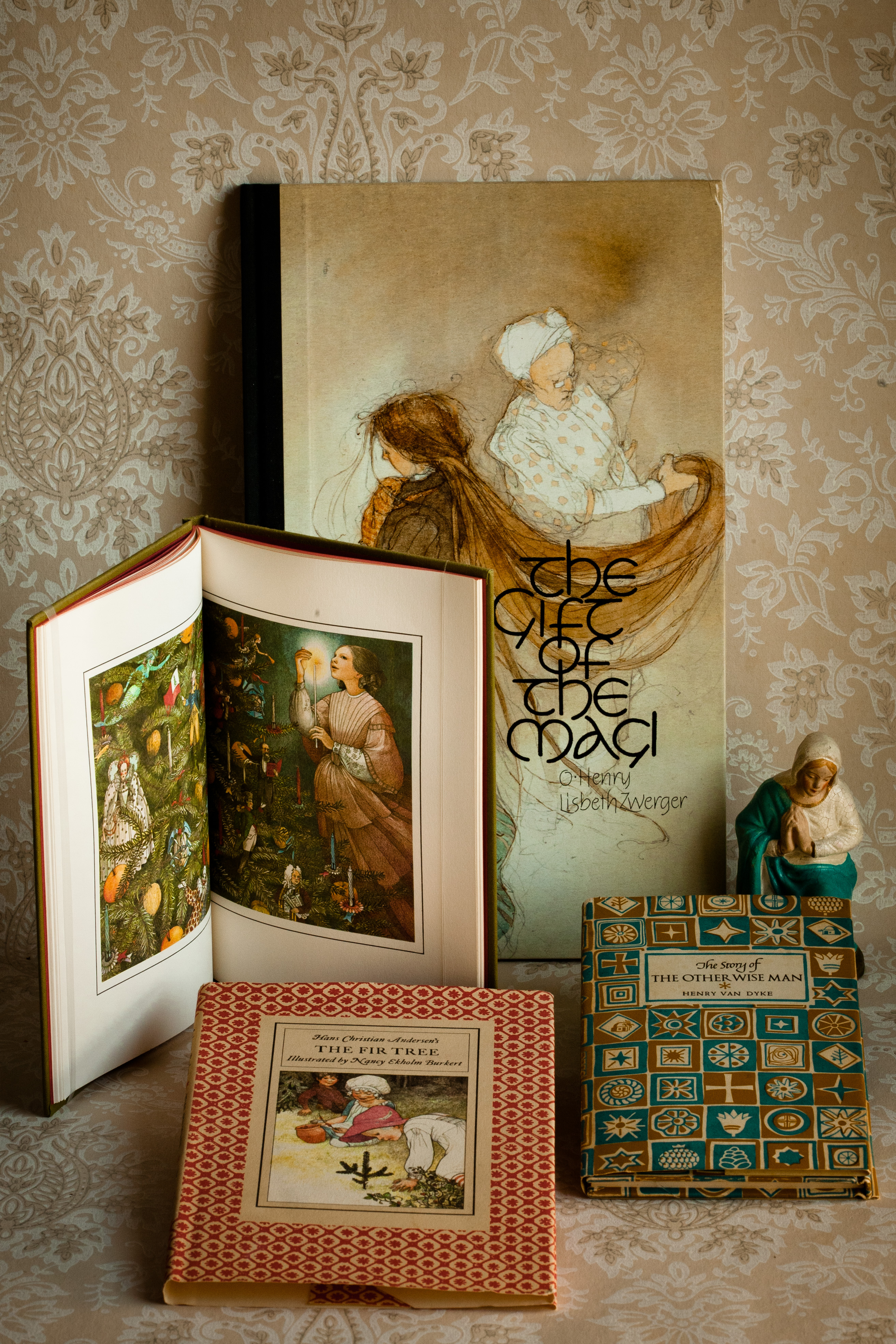
The Story of the Other Wise Man, by Henry Van Dyke,  Illustrated by Ruth McRae, Peter Pauper Press.
The Fir Tree, by Hans Christian Andersen.  Illustrated by Nancy Ekholm Burkert, translated by H. W. Dulcken.  Harper & Row, 1970
The Gift of the Magi, by O. Henry.  Illustrated by Lisbeth Zwerger, with type by Michael Neugebauer.  Picture Studio/Neuegebauer Press, 1982.

The point of this exercise initially was to discover illustrated books, primarily used, that I could make some pretty pictures with.  Limiting my search to cheap used books meant that I was always browsing other people’s cast offs.  Someone – or no one – wanted these books any longer, and they must not have wanted them real bad.  If you wanted to keep them, you could certainly find the room.  See how skinny they are?

But Bill, Mary and Julie were done with “The Fir Tree.”  “Christmas, 1989,” had finished with O. Henry.  And no one ever cherished  “The Other Wise Man” enough to brand it with so much as an initial.  Truth be told, I didn’t want these books  either, when I bought them.  Too sad, I thought.   Hans Christian Andersen is responsible for what is possibly the most cold hearted “fairy tale” tragedy ever told, The Little Match Girl.  And the wounded pride of O. Henry’s couple made me cringe the first time I read it in high school.  Nonetheless, into the box they went – because of their beautiful images, because I buy Peter Pauper editions on principle, and because they filled my most important criterias:  cheap and pretty.

This year, though, these sad friends feel like true friends.  The characters, lead astray by vain aspirations to fulfill a Christmas quest, pulsate sympathetically with my own vulnerability.  I see how they endure their mortal disappointment, only to discover it has been transmuted into something new through love.  I trust their self-centered, misguided actions.  I even love them for their honest frailty.

Maybe I knew someone who sacrificed her greatest treasure to keep her pride (The Gift of the Magi).  Or the urgent beauty of the present moment is finally seeping through some fissures in my Fortress of Might-Have-Been (The Fir Tree).  Or the glow of Artaban’s Pearl of Great Price, at the fulfillment of his journey, illuminates an unanticipated freedom – even joy and peace – for me, too:

What had he to fear? What had he to hope? He had given away the last remnant of his tribute for the King. He had parted with the last hope of finding him. The quest was over, and it had failed. But, even in that thought, accepted and embraced, there was peace. It was not resignation. It was not submission. It was something more profound and searching. He knew that all was well, because he had done the best that he could from day to day. He had been true to the light that had been given to him. He had looked for more. And if he had not found it, if a failure was all that came out of his life, doubtless that was the best that was possible. He had not seen the revelation of “life everlasting, incorruptible and immortal.” But he knew that even if he could live his earthly life over again, it could not be otherwise than it had been.

This year, I heap blessings on O.Henry, and Van Dyke, and even on Mr. Andersen, whose blind and unlucky protagonists reassure me that I am not alone. Loss and hope inevitably mingle on Christmas day.  Perhaps that is, finally, a reason to celebrate – to see that, while painful, failure has been the path, all along, and I am in good company.

And that’s what Christmas is all about, Charlie Brown.

Posted in Uncategorized

Booked for Christmas – Before and Since

_MG_5821

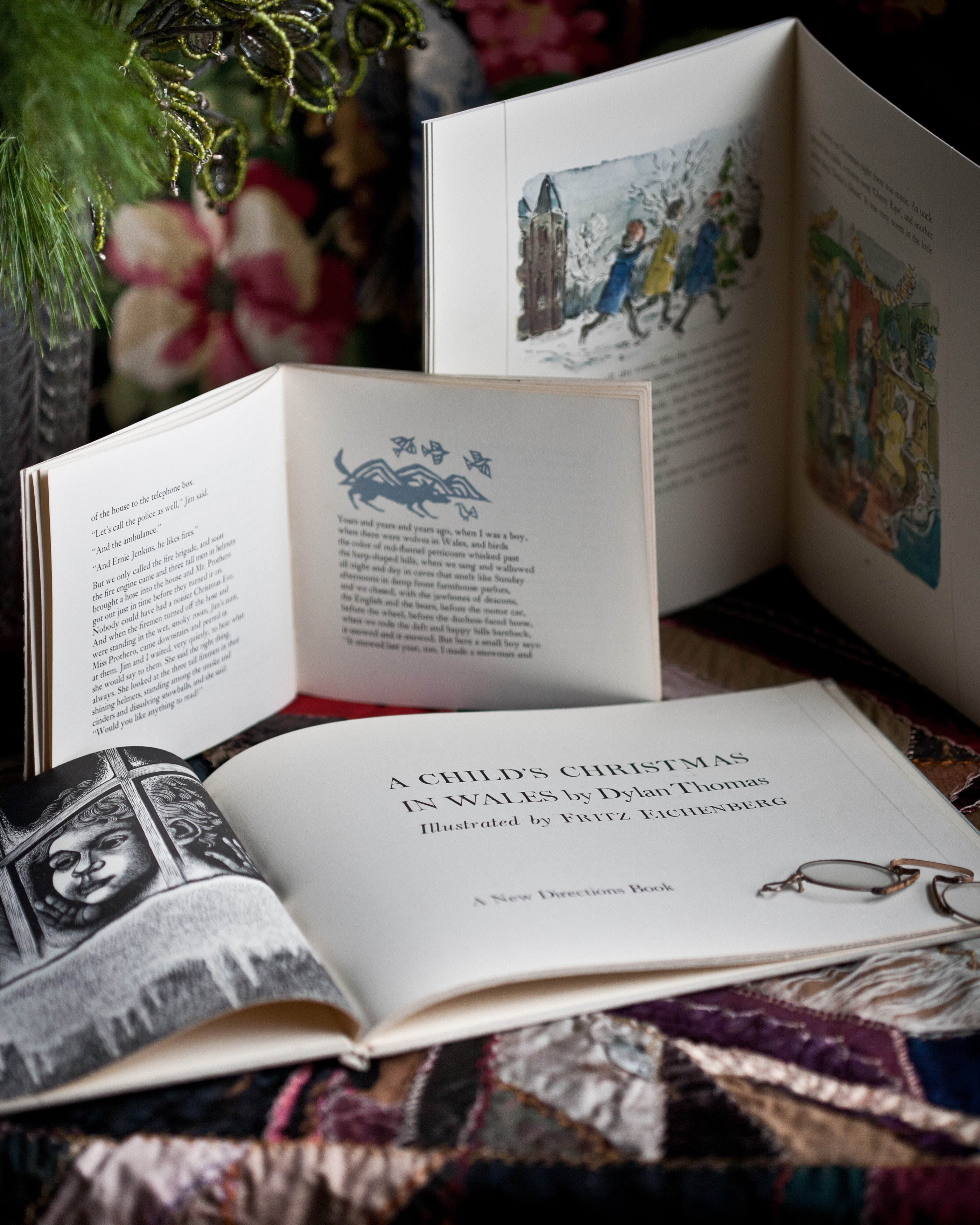
Editions of A Child’s Christmas in Wales pictured above, top to bottom:  Orion Children’s, illustrationa by Edward Ardizzone, 1978; 1959 pressing by New Directions, woodcuts by Ellen Raskin, 6th printing;  1969 New Directions illustrations by Fritz Eichenberg

The moment remains distinct for me – as clear as any memory I have.  It’s a weekday afternoon, an unremarkable day.  I’m about 19 or 20, and I have no reason to be anywhere except the Art Institute of Chicago.  I’ve wandered into an early 20th century gallery, where I expect to find a Magritte to look at.  It’s the 80s, so there’s a lot of bad Magritte-style graphics everywhere.  The Magrittes are there, of that I’m sure.  But there’s something else in this gallery.  A painting full of sound and movement –  the rush of ocean, the splash of pink tile, the puff of curtains waving.  The canvas is drawing me like a magnet, speaking to me with its own voice.  I stand, looking and looking and looking, as if I am hearing through my eyes.  The painting itself teaches me how to enter a piece of art, on its own terms, for the first time.  The painting is Interior at Nice, and my experience of art and beauty divides on this day into “before and after Interior at Nice.”  Clear as a bell.

I have to steep myself more deeply in memory to recall the incandescent moments when I heard A Child’s Christmas in Wales for the first time.  Heading home from the library through dark fog, I think and think and think.  No, not then, not there but… Yes, already there, by then for sure...  How can I not remember when we met, this prose poem and me?  It makes me feel sad, like friends drifting apart, and so….My mind starts to chew on something else as I clomp beneath the giant glowing snowflakes that cling to the light poles, decorating the street for Christmas.  A little chef’s salad forms in my mind, with iceberg lettuce and smoked turkey and  a sprinkle of blue cheese and rosy orange dressing.  This means a trip to Miller’s Grocery, the glowing repository of Whatever You Could Possibly Want for Dinner.

Outside the store, heaps of balsam rope and wreathes spice the air with the hopeful smell of sap that is ever-green.  Inside, it’s good – bright, part of a crowd, something to accomplish.   Just ahead, a Lady skates out of an aisle, elegant in her red princess style coat and red pants, pushing a tiny cart as she glides one black patent shoe in front of the other.  Her grace and self possession make me smile under my breath.  Being just six or so, the Lady can still hear such smiles, and looks up to meet my eyes as I pass her on my way to Produce.

Checkout Girl sends me on my way with my delicacies, past the Red Kettle Bell Ringer, through the self-opening doors, back along Balsam Lane, towards home.  I am planning my rosy-orange salad dressing as I cross the wet, dark pavement. And It hits me.  I hear my own voice, repeating Dylan Thomas’s spell…“I plunge my hands in the snow and bring out whatever I can find”  – every syllable teaching me English as if it were a language I had never heard before. I feel myself waiting as other voices take their turn, affirming the sea has two tongues and that one Christmas is so much like another that you cannot remember any of them without remembering all.  And I remember.

It was a fancy party, we were the entertainment, transporting any guests who paused to listen to the sea-town corner where Dylan Thomas unearthed his Christmas.   It seemed an innocent enough thing to do – to perform, to act, to bring these words to life.   But for me there were repercussions.   Speaking the words allowed the poem get inside me, work on me, remake me.    Before A Child’s Christmas in Wales, I thought words were tools I used.  Since then, I have spent my  life learning that is preposterous.  I am the Tool.  The Words have All The Power.

My reverie is dark  and bright, and chilly and warm, and sweet, and requires all my concentration.  My legs walk me home and up the steps  to my front door without any help. I have Iceberg Lettuce in a brown grocery bag, and cold selzer in the icebox.  The incandescent light glows companionably.  I’m not sad.  I don’t have to remember about the poem anymore.  It remembers me.   And that is a good place to begin.

Posted in Uncategorized

Booked for Christmas – America for Christmas

_MG_5659-2

Books and Christmas go together like Jingle and Bells.  From Scrooge to Eloise, our literary Christmas friends have the power, year after year, to renew and revitalize whatever tale it is we need to tell ourselves to endure and even enjoy this bittersweet season.   I began collecting odd and interesting Christmas books last year, and now I think I have enough to get us through until Christmas Eve.  Or not – you know how this tends to go.

There may be some obvious omissions:  I haven’t found a really neat Nutcracker yet, for instance.  But I hope you’ll meet some new friends, and see your dearest Christmas companions in a new, twinkly light.

We’ll start right here at home, with Christmas through a classic American lens.

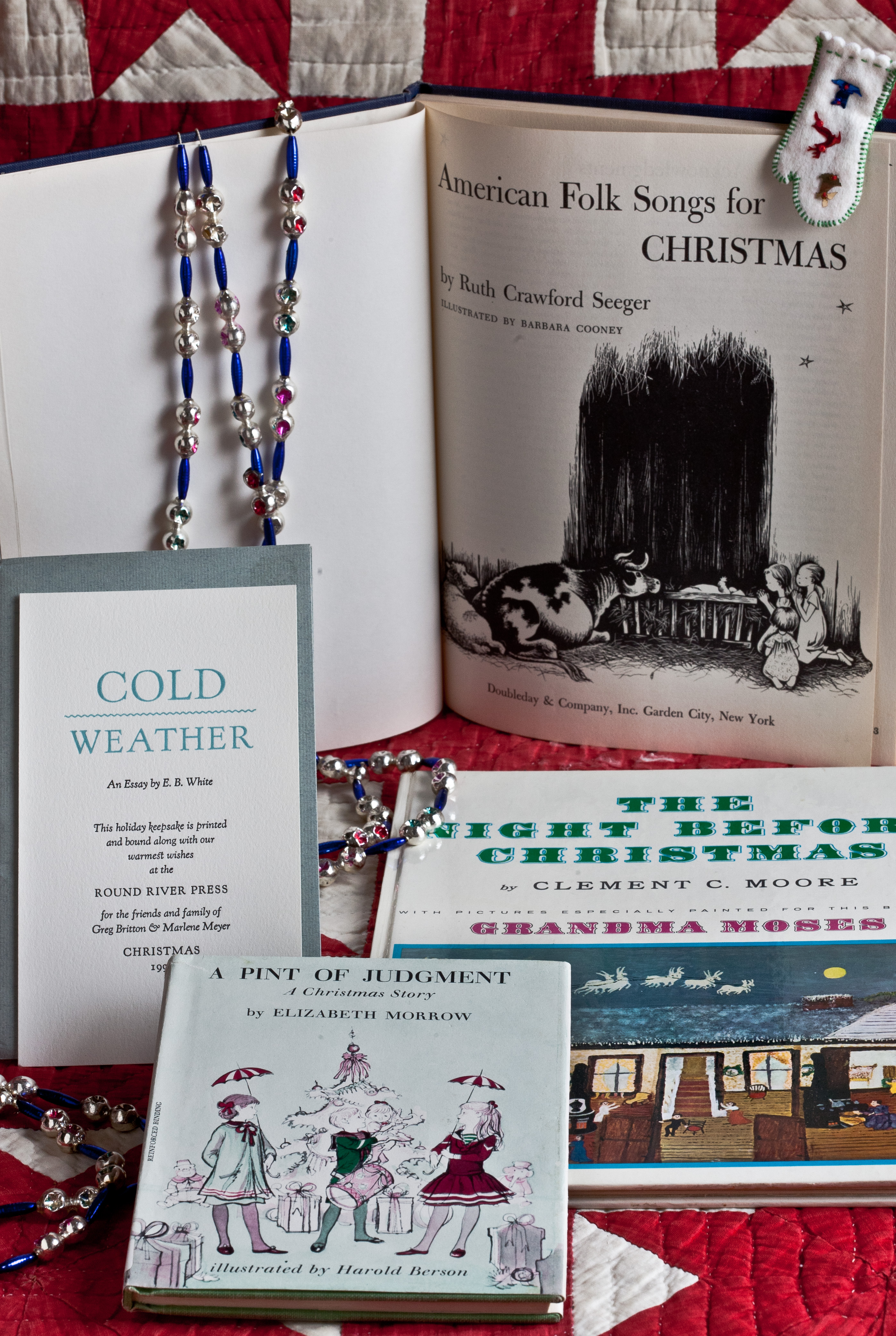
The Night Before Christmas (A Visit from St. Nicholas), illustrated by Grandma Moses –  The Night Before Christmas is an enterprise like none other – Amazon has over 13,000 listings for this title in Books alone.  The verse is so familiar it offers a virtual blank slate for the skills of countless illustrators.  In her joyous imagining of Clement Moore’s poem, Grandma Moses’ pictures portray the tale just like a child – in pure deep colors, with narrative details splashed around where they are easily seen. Everything seems to happen at once, in dream-like vistas where distance and perspective serve the elements of the story, not reality.  If you don’t mind an ex-library book, you can get the 1991 reissue for $1.  A clean 1976 reprint of the 1961 original runs about $30, unless you find it at a used book sale for .50.  Which I did.  Sorry.

American Folk Songs for Christmas by Ruth Crawford Seeger (Pete’s stepmom), illustrated by Barbara Cooney
This book deserves a feature post of its own, and that’s just my intention.  What I didn’t realize when I bought my vintage copy was what an incredible artist Ruth Crawford Seeger was, or that illustrator Barbara Cooney created Miss Rumphius – one of my most favorite children’s’ books. (We’ll peek inside for a future post.)    Newly reissued in paperback by Loomis House Press, as of 2013 you can give the joyful, distinctly American music to yourself or some sweet family you love.  The Seeger Sisters’ recording of American Folk Songs for Christmas is available for download from Smithsonian Folkways.

Not really Christmas but every adult needs a copy of Cold Weather, a brief essay by E.B. White  (available in One Man’s Meat, White’s collected essays for Harper’s).   It would be cheating to just reprint the whole thing here, but I might quote from it very liberally soon as part of this series.  My chapbook edition is number 103 of 125 printed by hand right here in Madison, WI.  Couldn’t find it on the internet – that doesn’t happen often.  I guess my .25 was well spent.

A Pint of Judgment by Elizabeth Morrow (mother of Anne Morrow Lindbergh), illustrations by Harry Berson.  This little treasure, originally published in 1939 with pictures by Susanne Suba, is set in the home of thoroughly modern, turn of the century, distinctly New York family. We’ll peek inside this one, too.

As often happens with Christmas intentions, it’s taken about 6 times longer to get this home-made present ready for you than I planned, and it’s not as pretty as I wanted.  Still, I hope it fits.  More books tomorrow.  Which is today.  Ooooh, do I hear reindeer??!  (no, just the world’s largest raccoon…sigh…)

Posted in Uncategorized

Grateful

_MG_5226-2

It was the story of Eeyore’s lost tail that came to mind first.    Eeyore is reunited with his tail by Pooh’s efforts to restore happiness and wholeness to his habitually glum friend.  But then there was the story of Eeyore’s Birthday and that seemed to sum things up pretty well.

Having discovered that Eeyore was in need of a birthday party and presents, Pooh and Piglet each choose a cherished possession of their own to give him – a jar of honey and a red balloon, respectively.  Feeling peckish, Pooh slurps down the honey on his way to give it to Eeyore, leaving him with only a Useful Pot for a present.  Overexcited, Piglet trips and bursts the balloon as he runs, leaving him with a limp red rag for his gift.

…When Eeyore saw the pot, he became quite excited.  “Why!” he said.  “I believe my Balloon will just go into that Pot!”
“Oh, no, Eeyore,” said Pooh.  “Balloons are much to big to go into Pots.  What you do with a balloon is, you hold the balloon –”
“Not mine,” said Eeyore proudly.  “Look, Piglet!”  And as Piglet looked sorrowfully round, Eeyore picked up the balloon with his teeth, and placed it carefully in the pot; picked it out and put it on the ground; and then picked it up again, and put it fully back.
“So it does!” said Pooh.  “It goes in!”
“So it does!” said Piglet.  “And it comes out!”
“Doesn’t it?” said Eeyore.  “It goes in and out like anything.”
“I’m very glad,” said Pooh happily, “that I thought of giving you a Useful Pot to put things in.”
“I’m very glad,” said Piglet happily, “that I thought of giving you Something to put in a Useful Pot.”
But Eeyore wasn’t listening.  He was taking the balloon out, and putting it back again, as happy as could be…

Giving thanks, all month long, has made one fundamental condition as plain as Thanksgiving Day:  We have to take the bitter with the sweet.    Eeyore’s gift, his Great Gift to his Friends, is to know when things are sweet and to share his Joy, which is certainly another word for Gratitude.  I don’t think my task is to go beyond moping into some kind of infernal sunshine, nor to lower my sights in resignation.  I think my challenge is to be touched, to willingly change gears and acknowledge when a Useful Pot and Something to put in it, is just what I needed.  My friends, on their own journeys, have met me with these things at just the right moment.   And for this, not just today, I feel much gratitude.  Which is certainly another word for Joy.


Posted in Uncategorized

Grateful Contrast

_MG_5002

It may be that in thinking about gratitude this month, I have begun to conflate it with forgiveness.  The two actions seem related, if not predicated on each other.  There’s no impasse.  I can be grateful and go on feeling hurt.  I can feel compassion and understanding for what happened, and still wish things had been different. But, as with the light and dark in this curtain, it’s hard to pinpoint where one begins and the other leaves off.   The background moves from light to dark, as the surface undulates. One side catches more reflected light;  the other side inevitably recedes  into shadow.  The pattern doesn’t alter, only its relationship to the light.  You can see the evidence of the change with your own eyes, but which surface is closer to the viewer, the light or the dark?  I honestly can’t tell, and I was there.

Posted in Uncategorized

Grateful Challenged

20131120_140831-2

This tree is putting on quite a show.  It’s the only one with berries, a brazen red surprise, surrounded by the hollow remains of tall grasses and silver stalks of spent milkweed.  I’ve been trying to get to know it but the wind always seems to get there first, shifting the network of shapes and lines before I can see anything.  Finally, today I just gave up.  I stuck the phone in front of the reddest branch and wished upon a star for something pretty to happen.

I also bought a notebook today, to write thank yous in.  It seems so obvious, why didn’t I think of it before?  (Because Oprah did, that’s why.  Damn.  I forgot that.)

Like I said on day one, giving thanks all month long promised to challenge me.  If all you wanted to hear were the good parts, you might want to skip ahead to the end.  Let me know what you find when you get there.  I’m still sorting this out, myself.